
The Look at That Game, A Practical Guide for Dog Guardians
What Is the Look at That Game?
The Look at That game, often shortened to LAT, is a pattern game developed by Leslie McDevitt, author of Control Unleashed.
It is designed to help dogs feel calmer and more thoughtful around things that normally trigger big reactions, such as other dogs, people, bikes, or sudden movement.
At its core, LAT teaches a dog:
You are allowed to notice the thing
You do not need to react to it
Looking at it calmly makes good things happen
Instead of trying to stop your dog from looking at a trigger, you actually encourage it in a structured way.
This shifts the emotional response from tension to curiosity.
Why It Works
Many reactive dogs are not “naughty”. They are overwhelmed, uncertain, or over aroused.
When a dog sees something challenging, adrenaline spikes. The body prepares for action. Barking and lunging are often attempts to create distance.
LAT works because it:
Reduces pressure
Gives the dog a job
Builds predictability
Changes the emotional association
Over time, the trigger becomes a cue to check in rather than explode.
How to Teach the Look at That Game
Start somewhere quiet. Do not begin with your dog’s biggest trigger.
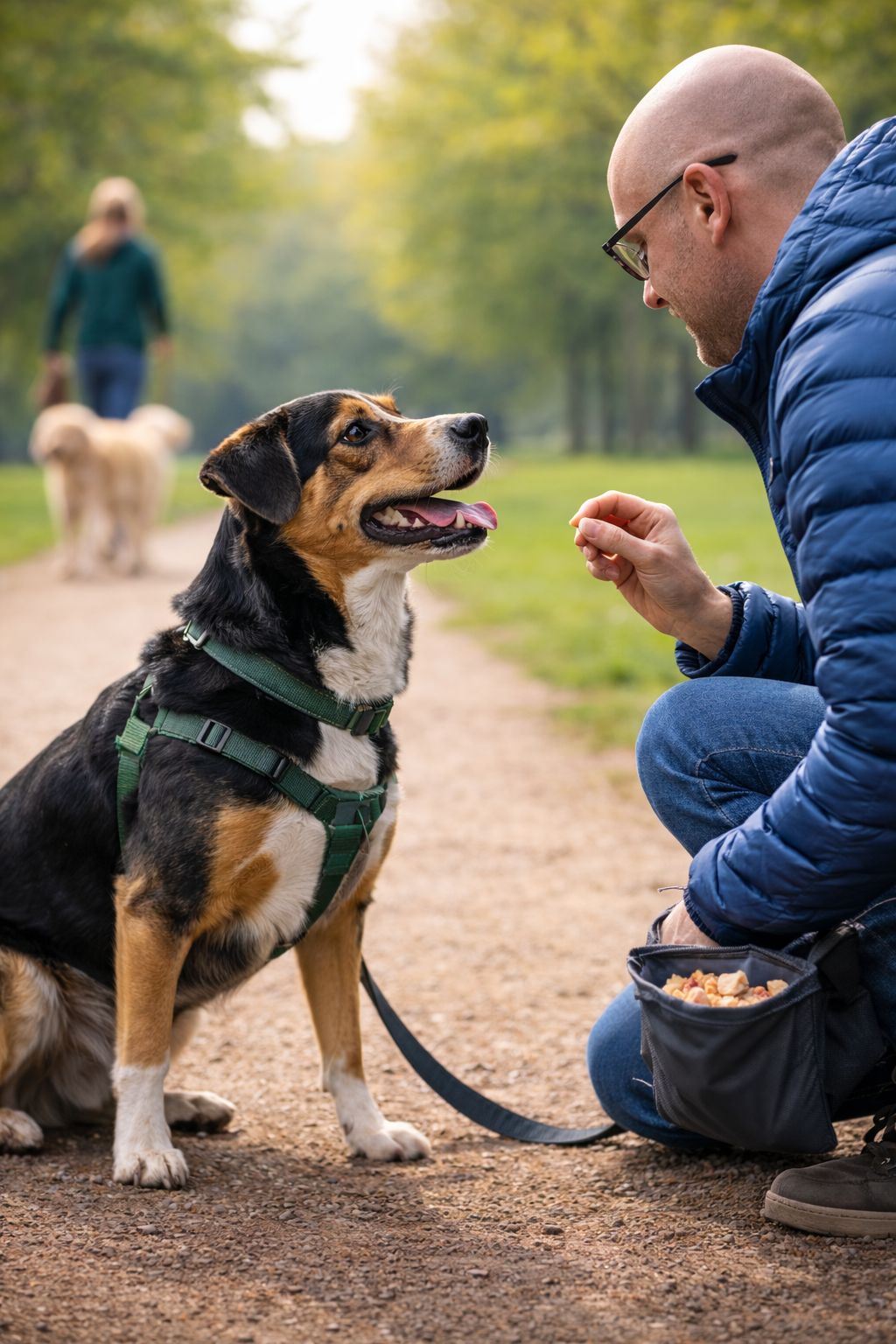
Step 1: Mark and reward noticing
When your dog looks at a neutral object in the distance, for example a parked car or a tree:
Let them look
The moment they glance at it, say your marker word, for example “yes”
Deliver food
At this stage, you are marking the act of looking.
Step 2: Wait for the head turn
Very quickly, your dog will begin to:
Look at the object
Then flick their head back to you
Now you mark the head turn back to you.
The pattern becomes:
Trigger → Look → Return to guardian → Reward
That head turn is gold. It means your dog is thinking.
Introducing Real Life Triggers
When moving to real triggers such as other dogs:
Start at a distance where your dog can still think
If they are barking, lunging, or frozen, you are too close
Reward calm noticing
Distance is not avoidance. It is how learning happens.
Common Mistakes
Working too close too soon
Talking too much
Asking for a sit or other behaviour
Withholding reinforcement
LAT is about observation and emotional shift, not obedience.
When to Use LAT
Use LAT when:
Your dog fixates on other dogs
Your dog barks at movement
Your dog becomes tense before reacting
You want to change how your dog feels about something
LAT is especially powerful for dogs who need help processing the world safely.
Who Should Not Use It Alone?
If your dog:
Has a bite history
Redirects onto you
Shuts down completely
Cannot take food outdoors
Seek help from a qualified, force free behaviour professional.
This game supports behaviour change. It is not a replacement for full assessment where needed.
The Bigger Picture
LAT builds emotional resilience.
You are not teaching your dog to ignore the world. You are teaching them that the world is safe to observe.
Over time, many guardians notice:
Softer body language
Faster recovery
More spontaneous check ins
Reduced intensity of reactions
It feels subtle at first. Then one day you realise your dog looked at another dog and chose calm.
That is learning.
If You Want More Structure
If you would like a pattern game that gives your dog something specific and rhythmic to do as you move through challenging environments, read my guide to the 123 game next.
Want to know more about Dave’s Dogs?
Head over to here to read about dog walking in Colchester.