
Your Dog Loves the Ball Thrower. That Doesn't Mean It's Good for Them.
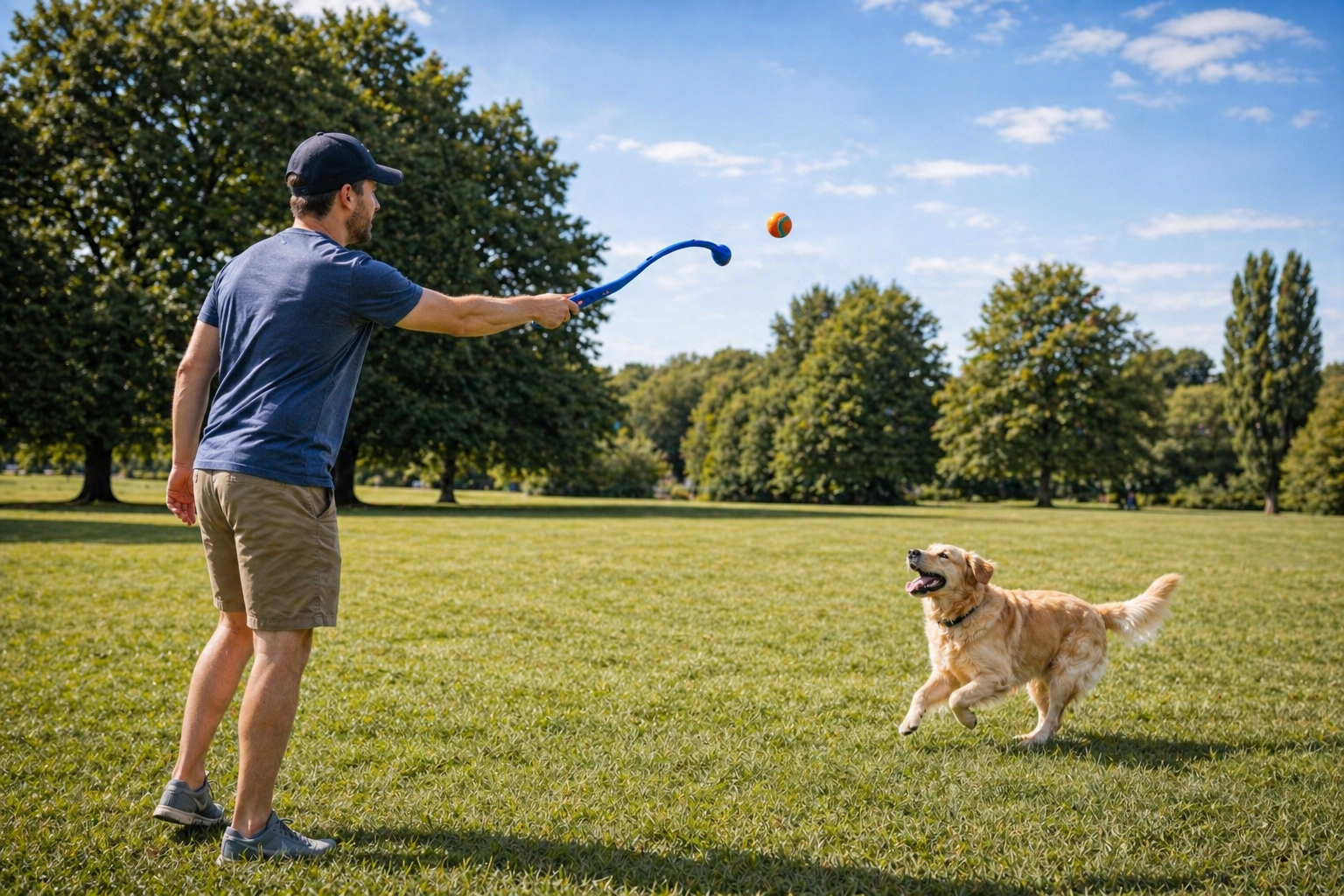
Ball throwers are everywhere. They're simple, dogs get excited as soon as they see one, and they seem like an easy way to burn energy.
I don't use them on my walks. That comes from seeing how dogs move, behave, and recover over time, not just how they look in the moment.
I Used One Too!
I'll be honest, I didn't always think this way. When I got my Labrador years ago, ball throwers were everywhere and I didn't know any better. He loved it, so I used one fairly regularly when he was young. It felt like the normal thing to do. It was only when I started educating myself properly that I stopped, but I've always carried a nagging feeling that those early years took their toll. He developed terrible arthritis as he aged, and while I can't say for certain what caused it (other than age), I've never been able to fully shake the thought that all those high impact sprints played a part.
What Fetch Actually Does to a Dog's Body
Fetch involves a lot more than casual running. You've got full speed sprints, abrupt stops, tight turns, and twisting through the body to grab the ball. Those are high load movements, and when they're repeated heavily in a single walk, the strain builds quickly.
Almost all dogs won't pace themselves either. They'll keep going without hesitation, even when they're fatigued. That makes it very easy for sessions to go beyond what their body can comfortably handle.
A ball thrower increases the intensity again. The distance is longer, the pace is faster, and the pattern becomes relentless. It doesn't take long before a dog has done a large number of high impact sprints in a short space of time.
There's also very little variation. The body is being asked to perform the same movement pattern repeatedly, rather than moving in a more natural way across different terrain and at different speeds.
A Word on Warm Days
And yet you'll still see people out there on warm days, launcher in hand, sending their dog tearing across the field over and over. A dog that's already panting, already slowing, but the ball keeps going. Heatstroke in dogs can come on quickly and it can be fatal. It's one of the more avoidable things that happens to them.
The Bit Most People Don't Consider
The physical side is only part of it though.
Chasing a ball taps directly into a dog's chase instinct. That's why it's so engaging. The problem is how stimulating it is, especially when it's repeated over and over.
You often see dogs become highly fixated on the ball. Their focus narrows, their arousal rises, and their ability to take in anything else drops. That includes you.
This is where disengagement becomes important. A dog that can't easily come away from something it finds exciting will struggle in other areas too. That can show up as pulling towards other dogs, overreacting to movement, or finding it difficult to settle when something catches their attention.
For some dogs, that constant cycle of high stimulation feeds straight into reactivity. They're already running at a higher baseline, so it takes less for them to tip over into barking, lunging, or losing control.
I see plenty of dogs who aren't short on exercise, but are still struggling behaviourally. When you look closer, a lot of their activity is built around this kind of high intensity, repetitive play.
They're physically worked, but mentally they're constantly being pushed into a heightened state.
Over time, that can build a dog that is fitter and more driven, but also more easily overstimulated and harder to settle.
How My Walks Are Different
On my walks, the focus is different. Dogs still move, but in a way that allows them to stay more balanced. They get time to sniff, explore, and take in their surroundings. Movement is varied, not repetitive. The social side is calm and structured, with dogs that suit each other.
You end up with a dog that's fulfilled without being wired, and able to switch off when they get home.
A game of fetch now and then isn't an issue on its own. The problems tend to show up when it becomes a regular, high intensity routine.
A Better Way
If you're looking for an alternative that gives your dog a genuine outlet, scatter feeding is worth trying. Take some of their kibble or a handful of small treats and scatter them through the grass. Then step back and let them work. The nose takes over, the pace drops right down, and the dog is completely absorbed. It looks unimpressive from the outside but it's genuinely tiring in the best possible way.
You can start in a small area and gradually spread it wider as they get the hang of it. No equipment, no training needed, and no dog has ever come away from a good sniff session wired and unsettled.
If you want to take it further, scent work is a brilliant activity and something dogs of any age and breed can enjoy. If you're local to Colchester, Fiona at Mersea Mutts is well worth a look. And wherever you are, it's the kind of activity that's easy to find locally once you start searching for it.
Dogs will always go again if the ball is thrown. That doesn't always line up with what's best for them.